
I put a team of 8 AI employees on one small box and ran them overnight
This week I left one small box on my desk running overnight with a team of eight "AI employees" on it. The question was simple: could one small computer run a whole team on a real small-business project, with no cloud, no API keys, and no monthly subscription?
I ran two open-source agent engines against each other: ZeroClaw and Hermes Agent by Nous Research.
This is what happened.
The box and the model
The box is the O1 (Beta), a single-box AI workstation with 93 GB of memory shared between the processor and the graphics chip. No cloud, no API keys. Every agent on the team shares the same model, Qwen3.6-35B-A3B at 4-bit quantisation, running locally. The inference queue handles four requests at a time.
Inference is unlimited once you buy the box. There is no per-token bill.
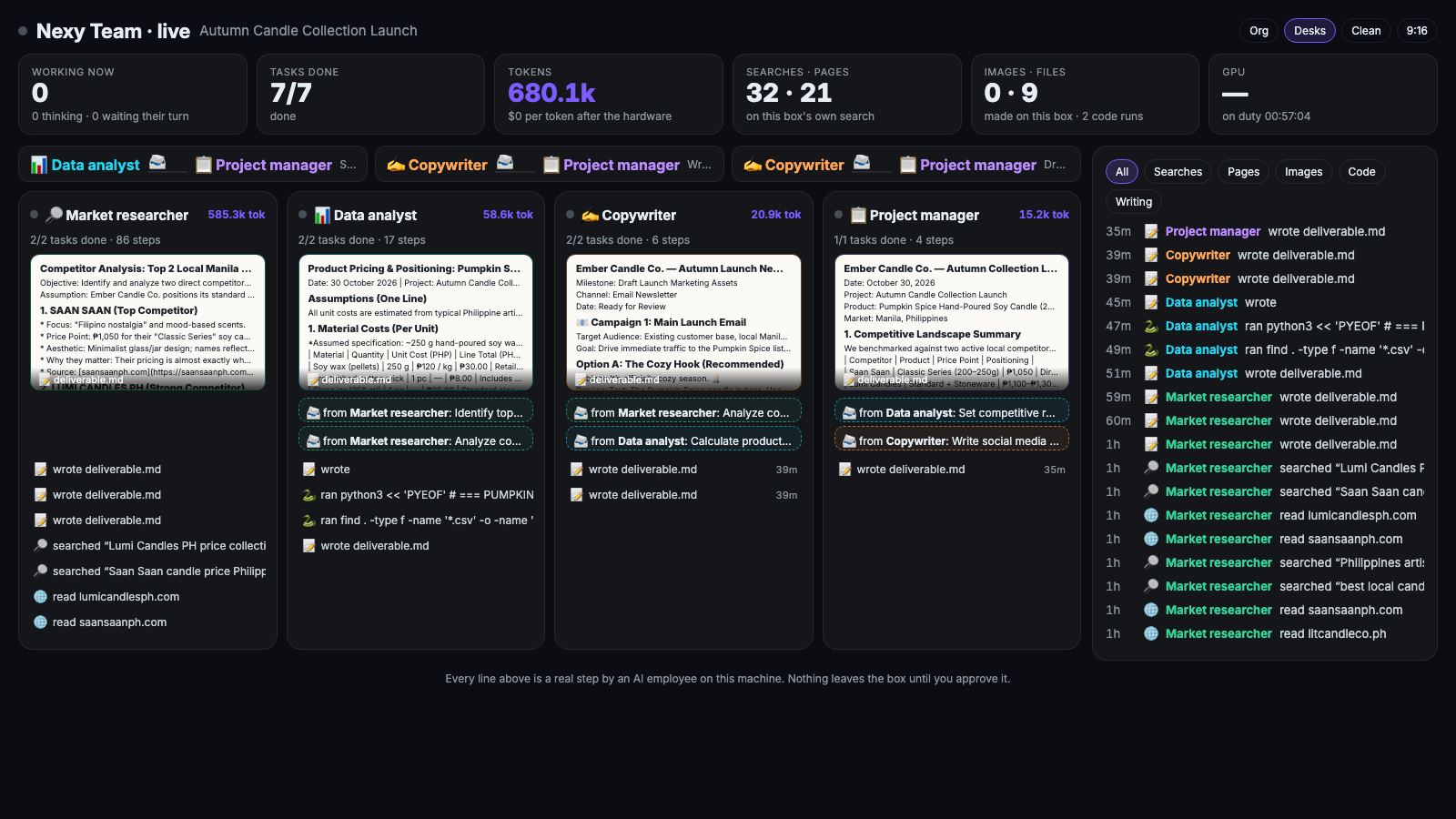
The test business and the team
The project was for "Ember Candle Co", a fictional hand-poured candle shop in Manila. The data pack contained 80 real-looking orders in a sales file, expenses, customer reviews, competitor info, a customer inbox, and brand rules. The right answers were known, so I could grade the work accurately.
The team was seven specialists working in parallel, then a project manager reading their work:
- Research: competitive analysis
- Data analyst: sales report with exact totals by product, channel and month
- Bookkeeper: profit and loss
- Content: five social posts
- Email: newsletter draft
- Support: four customer replies
- Web: a landing page
- Project manager: a launch brief pulling together everyone's work
How it was graded
A script checked things an owner would notice: exact revenue, expenses, and profit figures, every product price on the landing page, the correct policy quoted to customers, no banned health claims, and the project manager citing teammates' work. Each of the eight roles counted equally, so a missing deliverable cost a whole role.
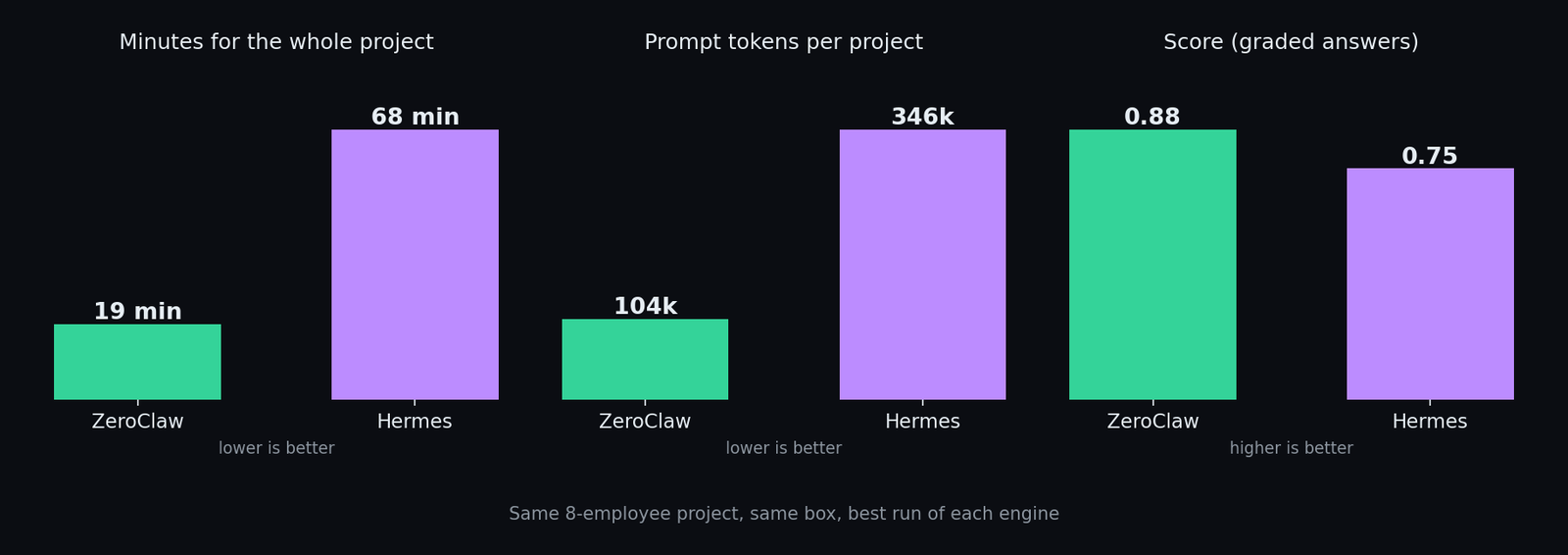
| ZeroClaw (best runs) | Hermes (best runs) | |
|---|---|---|
| Deliverables | 8 of 8, 7 of 8 | 6 of 8, 5 of 8 |
| Score | 0.877, 0.843 | 0.75, 0.625 |
| Time for the whole project | 19 to 23 minutes | 68 minutes |
| Prompt tokens per project | about 100,000 | 350,000 to 420,000 |
| Memory per agent | about 30 MB | about 270 MB |
ZeroClaw was 3 to 4 times faster on 4 to 12 times fewer tokens.
The single-agent tests
I also ran simple one-off tasks. The results tell a story about overhead:
| Task | ZeroClaw | Hermes |
|---|---|---|
| say hello | 7.3 s, 1,800 tokens | 8.8 s, 8,000 tokens |
| write a file | 19.8 s, 3,800 tokens | 27.0 s, 16,100 tokens |
Hermes's first call carries about 8,000 tokens of instructions and tool descriptions. ZeroClaw's first call carries about 1,900. That overhead matters when you are running a team.
What broke, and what we fixed
Not everything went smoothly. I will tell you what failed and how I fixed it.
The model server silently dropped large tool calls, anything over roughly 2,000 characters of HTML. Hermes's web developer delivered 0 of 3 because of it. We found the bug, fixed it, and sent the fix upstream. After the fix, the result was 10 of 10.
The server also refused extra requests with an HTTP 429 error instead of queueing them. A team of 7 to 8 agents needs a queue in front of the model server.
Agents that timed out kept running in the background and held the shared model for hours. Each run now cleans up after itself. The model sometimes wrote malformed tool instructions, and ZeroClaw gave up instead of retrying.
ZeroClaw was faster in part because it uses fewer model calls per project: 25 to 29, against 44 to 61 for Hermes. It does not run a full background service per agent. Each Hermes agent starts its own gateway at about 270 MB, so seven agents added 2 to 3.5 GB of memory on a box where that memory is also the graphics memory.
Hermes's own Kanban board mode was the slowest of all: over 1 million prompt tokens per project, and it stalled when one worker never marked its task done, so the project manager never started. Deliverables dropped to 5 of 8 and then 4 of 8.
The biggest lesson
Give anyone who touches numbers a code tool. The data analyst and bookkeeper were each run three times alone. Without Python, the 80-row sales report failed every time on both engines. Wrong totals, ran out of tokens adding numbers by hand, or a 30-minute stall. With Python, both engines were perfect, 6 of 6 runs. The model writes arithmetic out as text unless it has a calculator.
I also ran the box with 8 agents at once instead of 4. It was not faster. 20 minutes versus 19 to 23 minutes. The box's graphics chip is already fully busy at 4 concurrent requests.
The honest caveats
Two to three runs per setup, one model, one test business. These are small samples.
Hermes was tested with the build and tools I use. Other setups or models could score differently.
Some Hermes runs happened before the server fix, which hurt Hermes more than ZeroClaw. The speed and token gap does not depend on it.
ZeroClaw's best runs came after I fixed my own test settings, specifically time limits and output lengths. Earlier ZeroClaw runs were held back by my settings, not the engine itself.
Where this fits: Nexy
This benchmark was not a side quest. Nexy is the AI built into OwnOS, the operating system on the O1 (Beta), and it is designed so the engine underneath can be swapped. Today it already uses two: Hermes as the personal assistant you talk to, and ZeroClaw for the AI employees in a Nexy Team, the group that takes a project and works it in parallel. This benchmark is how that second choice was made, on evidence rather than hype.
The same box also runs other open-source agents, like IronClaw and OpenClaw. The plan is for Nexy to do what I did here by itself: test the engines on the box against each kind of employee, pick the best one for each role, and build the team around the project. It does not do that automatically yet. For now, I run the benchmark and Nexy uses the winner.
What I decided
ZeroClaw runs the AI employees. Hermes stays the main personal assistant.
I put one queue in front of the model, with room always kept for the owner's own chats.
Anything that goes outside the box, publishing, sending, paying, waits for the owner to approve it. This post went through exactly that system: the AI team drafted it, and it went live only after I clicked Approve.
Try it yourself
Both engines are free and open source. Pick one, give it a code tool, and hand it one real job from your own week, like totalling a spreadsheet or drafting replies to your inbox. Watch where it gets stuck. In my case the engine mattered, but the things around it mattered more: a calculator for the numbers, a queue in front of the model, and a human saying yes before anything leaves the box.
JOIN THE LIBERATI
Reclaim your happiness by automating the drudgery. Get the Sovereign AI Blueprints delivered to your inbox via my Skool.
No spam. Only alpha. Unsubscribe anytime.